
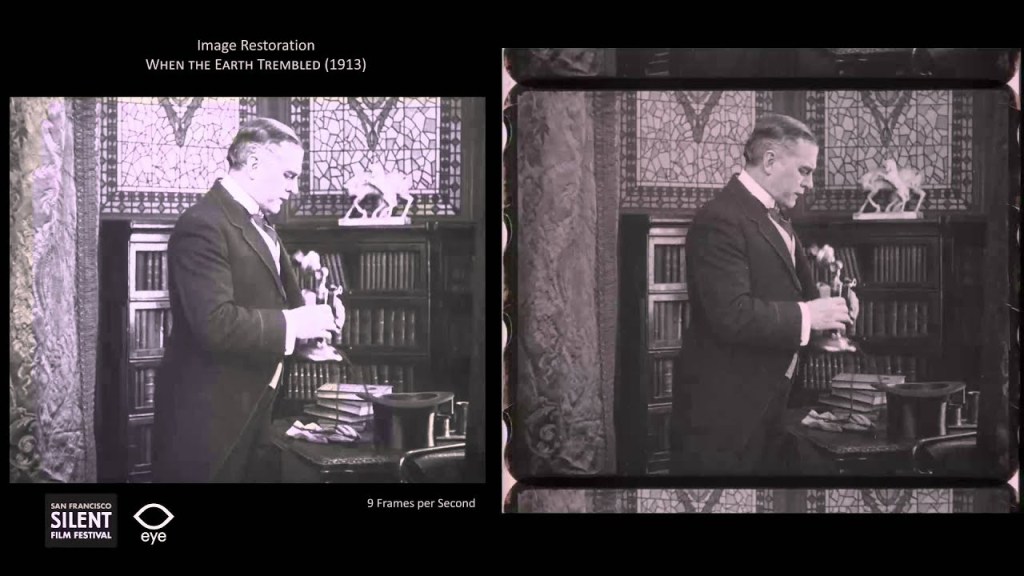
The President of the board of San Francisco Silent Film Festival Robert Byrne presented us a masterclass about the ‘holy grails’ and detection of work involved in finding ‘lost’ silent films and restoring them to our present period of time. Bringing a film back in its original state involves three main steps: (i) Restoration (reconstructing a specific version and remediates damage), (ii) preservation (the film is an artefact and must be preserved as any other historical artefact should be) and (iii) presentation (the ability to grant access of the film).
Film restoration involves a code of ethics, where you want to create a replica of the source material. Film restoration is as much of a research and historical research effort to reconstruct a film as well as restoring editing. Silent era film construction is much more than the silent era of filmmaking, as every film was released using a handmade film artefact and very little survives as of this day.
Mr Byrne went into incredible detail about this three-stage process in his lecture. He mentioned the useful revivals of silent film title cards (to convey emotion), old script drafts (to add a literary core in its narrative), even the constructions of colour, such as tinting and toning. Before a film is assembled, you would print 200 feet of any given colour so you can dye it at one time. Between every shot, they give instructions on how the colours are used (including the shot setting) and you’re alternating between interior and exterior scenes.
In terms of lining up each film source, frame by frame explores what shots they have and don’t have. Adding other information and what sources have titles and don’t have titles. Focusing on archival film, they remove all the damage they can find and half of it can be similar photoshop editing. After several months of editing, cleaning up, removing the flicker and grading them, colour reproduction, you now can grant access.
As an example of restored film, Mr Byrne showed us Irvin Willat’s lost film Behind the Door (1919), which was restored in May 2016 in partnership with the Library of Congress (American Domestic Negative) and the Gosfilmosfond of Russia (Foreign Export Negative). Even though the war was over, there’s an anti-German propaganda angle and was released when America was backing off from the propaganda films. “The new restoration uses all known film elements that bring to the screen most of the film’s impact. Irvin Willat is, for the most part, a forgotten director who was a dynamic personality during the silent era” (2017).
After listening to this masterclass, it made me realise that film restoration is like being in the field of archaeology. It’s all about studying the finds and restoring it to its original texture and quantity. They seem similar to time capsules and once someone finds them, they open windows into the past (or what’s left of it) and with the aid of technology that’s used today, helps them become immortal.
Works Cited
Byrne, Robert. “Restoring Treasures of the Silent Screen.” 21 Nov. 2019, Film & Screen Media Auditorium, University College Cork.
“Restoration of When the Earth Trembled (1913) – Before/After.” San Francisco Silent Film Festival, 2015, i.ytimg.com/vi/heOhz_CafwQ/maxresdefault.jpg. Accessed 29 Mar. 2020.
“San Francisco Silent Film Festival.” San Francisco Silent Film Festival, silentfilm.org/preservations/. Accessed 13 Mar. 2020.
San Francisco Silent Film Festival. “Restoration of When the Earth Trembled (1913) – Before/After,” YouTube, 2015, i.ytimg.com/vi/heOhz_CafwQ/maxresdefault.jpg. Accessed 29 Mar. 2020.
“The History Behind BEHIND THE DOOR (1919).” Flicker Alley, 4 Apr. 2017, flickeralley.com/the-history-behind-behind-the-door-1919/. Accessed 07 Mar. 2020.
 Adam Murphy's Blog